
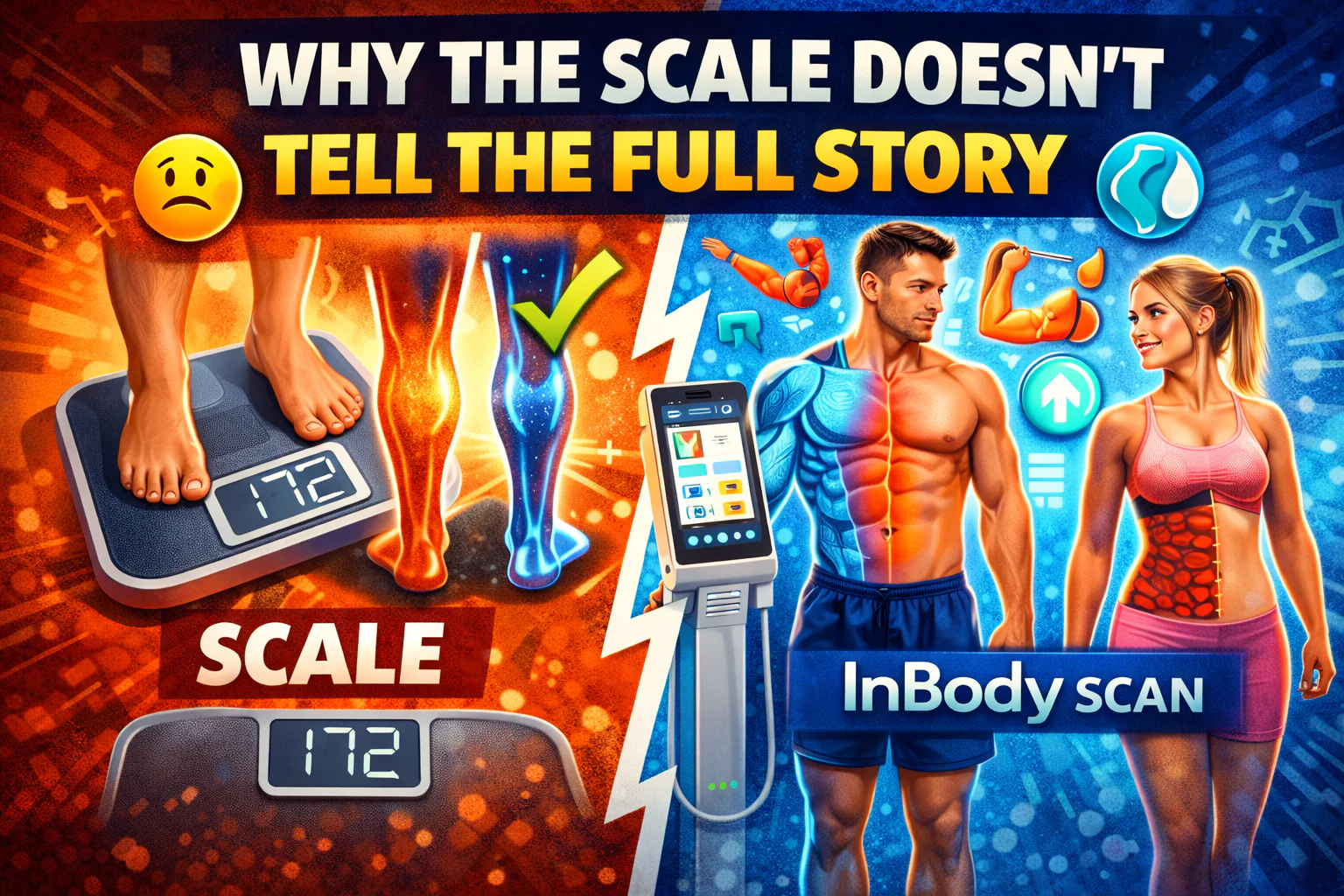
1. Introduction: Why the Scale Does Not Tell the Full Story
For decades, most people have relied on one number to judge their health and fitness. Step on a scale, see the weight, react emotionally, and move on. The problem is that body weight alone says very little about what is actually happening inside your body.
Two people can weigh the same and look completely different. One may carry more muscle, the other more body fat. Someone can lose weight while losing muscle, or gain weight while getting leaner and stronger. The scale cannot explain any of that. It simply reports total mass without context.
This gap is why body composition has become a more meaningful way to track progress. Instead of asking how much you weigh, it asks what your body is made of. Muscle, fat, and water all play different roles in performance, health, and how you feel day to day.
At boutique gyms like Mode in the West Loop of Chicago, this deeper understanding matters. Members are not just chasing a lower number. They are focused on building strength, improving health, and seeing progress that actually reflects their effort. An InBody scan is one of the tools that makes that possible.
2. What Is an InBody Scan?
An InBody scan is a quick, non invasive body composition assessment that breaks your body weight into meaningful components. Instead of showing a single number, it reveals how much of your body is made up of muscle, fat, and water.
This type of scan goes far beyond what a standard scale can offer. It shows where muscle and fat are distributed throughout your body and provides insight into areas that are often invisible, such as visceral fat and hydration status. That information helps paint a clearer picture of overall health and fitness.
An InBody scan is commonly used in fitness settings, medical clinics, and wellness programs because it delivers detailed data in a short amount of time. The results help people understand whether changes in weight are coming from fat loss, muscle gain, or shifts in water balance.
For anyone training with intention, especially in a personalized gym environment, this level of detail turns progress from a guessing game into something measurable and actionable.
3. How an InBody Scan Works
An InBody scan works by using a method called bioelectrical impedance analysis. While the name sounds technical, the concept is simple. Different tissues in the body conduct electrical signals in different ways.
During the scan, a very low and safe electrical current travels through your body. Muscle, fat, and water each respond differently to that current because they contain different amounts of water and electrolytes. By measuring how the current moves through your body, the device can estimate how much muscle, fat, and water you have.
What makes InBody technology more advanced than basic body composition scales is how detailed the measurements are. The device measures different parts of the body separately, including each arm, each leg, and the trunk. It also looks at water inside and outside of your cells, which improves accuracy and provides insight into hydration and fluid balance.
The process is completely painless and you do not feel the electrical current at all. There are no needles, no radiation, and no recovery time. The scan is designed to be quick, safe, and repeatable so progress can be tracked over time.
4. What an InBody Scan Measures
An InBody scan provides a detailed breakdown of your body composition rather than a single weight number. One of the core sections of the report focuses on total body composition. This includes skeletal muscle mass, body fat mass, and total body water, which together explain how your weight is distributed.
Another important component is body fat percentage. Unlike traditional measures such as body mass index, this number is shown alongside muscle mass and water levels, giving it much more context and meaning.
The scan also includes segmental analysis, which shows how muscle and fat are distributed across each arm, each leg, and the trunk. This can highlight imbalances or asymmetries that may affect performance, posture, or injury risk.
Visceral fat is another key measurement. This refers to fat stored around internal organs and is closely linked to metabolic health. Tracking visceral fat helps identify potential health risks that are not always visible from appearance alone.
Finally, the report includes detailed information about body water and fluid balance. By separating intracellular and extracellular water, the scan offers insight into hydration status and overall balance within the body.
5. What the InBody Scan Experience Is Like
An InBody scan is designed to be simple and efficient. Most people are in and out within a few minutes. You typically remove your shoes and socks and step onto the device barefoot. Depending on the setting, you may also be asked to remove heavy accessories or metal items.
Once positioned on the scanner, you hold the hand electrodes and remain still while the scan runs. The entire process usually takes less than two minutes and is completely painless. You do not feel the electrical current at any point.
As soon as the scan is complete, a detailed report is generated. This report can be printed or viewed digitally and is often reviewed with a trainer or coach. Having someone explain the numbers helps turn the data into practical insight rather than just a list of metrics.
6. Why People Use InBody Scans Instead of the Scale Alone
Many people turn to InBody scans because they want to understand real progress rather than relying on weight alone. The scale cannot tell you whether weight changes are coming from fat loss, muscle gain, or temporary shifts in water.
With an InBody scan, progress becomes clearer. Someone who is strength training may see muscle mass increase even if body weight stays the same. Someone focused on fat loss can confirm that changes are coming from fat rather than muscle. This clarity helps prevent frustration and misinterpretation.
The data is also useful for guiding training and nutrition decisions. Trainers can adjust programs based on muscle imbalances or low muscle mass. Nutrition strategies can be refined to better support performance and recovery. Instead of guessing, decisions are made using objective information.
Beyond fitness goals, InBody scans provide insight into health markers such as visceral fat and hydration. Tracking these trends over time can help highlight potential risks early and support long term wellness.
7. How InBody Scans Are Used in Training and Coaching
InBody scans are most effective when paired with personalized coaching. The data itself is only useful if it is interpreted correctly and applied to a plan.
Trainers and coaches use scan results to customize programs based on individual needs. If muscle mass is low in certain areas, strength work can be prioritized. If imbalances appear between limbs, training can be adjusted to address them. Recovery and conditioning can also be modified based on hydration and fatigue patterns.
In a boutique gym setting, this level of personalization is easier to deliver. Coaches have more time to review results, explain trends, and adjust programming as clients progress. The scan becomes part of an ongoing conversation rather than a one time measurement.
8. How Often Should You Get an InBody Scan

InBody scans are most useful when viewed as a long term tracking tool. A single scan provides a snapshot, but patterns over time reveal meaningful change.
For general fitness or weight management goals, many professionals recommend repeating a scan every four to six weeks. This allows enough time for muscle gain or fat loss to occur without encouraging obsession over small day to day fluctuations.
In more structured programs, such as medical weight loss or intensive training phases, scans may be done more frequently. The goal is always to monitor trends and adjust plans rather than chase perfect numbers.
Consistency in timing and conditions helps improve accuracy. Scanning at similar times of day and under similar conditions makes it easier to compare results over time.
9. Why InBody Scans Fit the Boutique Gym Model
Personalized data works best in personalized environments. Boutique gyms are designed around individual attention, coaching relationships, and long term progress rather than volume or speed.
An InBody scan provides detailed information that requires context and explanation. In smaller gyms, trainers can spend time helping clients understand what the numbers mean and how they relate to training, recovery, and lifestyle habits.
At Mode in the West Loop of Chicago, InBody scans support a coaching driven approach to fitness. Members are not left to interpret results on their own. Instead, the data is used to guide smarter training and support sustainable change.
10. Final Takeaway
An InBody scan offers a clearer way to understand what your body is actually made of. By breaking weight into muscle, fat, and water, it removes much of the guesswork from fitness progress.
For anyone focused on strength, fat loss, or long term health, body composition provides insight that a scale alone cannot. When paired with knowledgeable coaching and personalized training, the information becomes a powerful tool rather than just a report.
If you are looking for a more informed approach to fitness in the West Loop, using tools like InBody scans alongside expert guidance can help turn effort into results that truly reflect your work.